

Veteran Blue-Liner Tristan Thompson Relies on Patience, Communication, and Love of the Game
For veteran ECHL defenseman Tristan Thompson, the path to becoming a professional blue-liner started with watching some of the NHL’s best.
Growing up in Alberta, Thompson gravitated toward defensemen early, modeling his game after several players he admired. “My favorite players growing up were defensemen,” Thompson said during a one-on-one interview. “Andrew Ference on the Calgary Flames and Duncan Keith, and then I just stuck to it. Never really changed. I played maybe one game of forward growing up and then that was like, ‘oh, it didn't go too great.’ So I just stayed on defense.”
That early decision shaped the foundation of his game, but Thompson continued to study players whose styles reflected his own approach. “Probably Jared Spurgeon has been in the NHL for a long time. He's a smaller defenseman and he's really good on both sides of the puck offensively and defensively,” Thompson said. “So he's one of the players who I watched a lot growing up. And then being a Flames fan, Dion Phaneuf. I had to play more of a smaller game, and then more recently probably Torey Krug. But Jared Spurgeon's still one of the best defensemen in the NHL for what he does.”
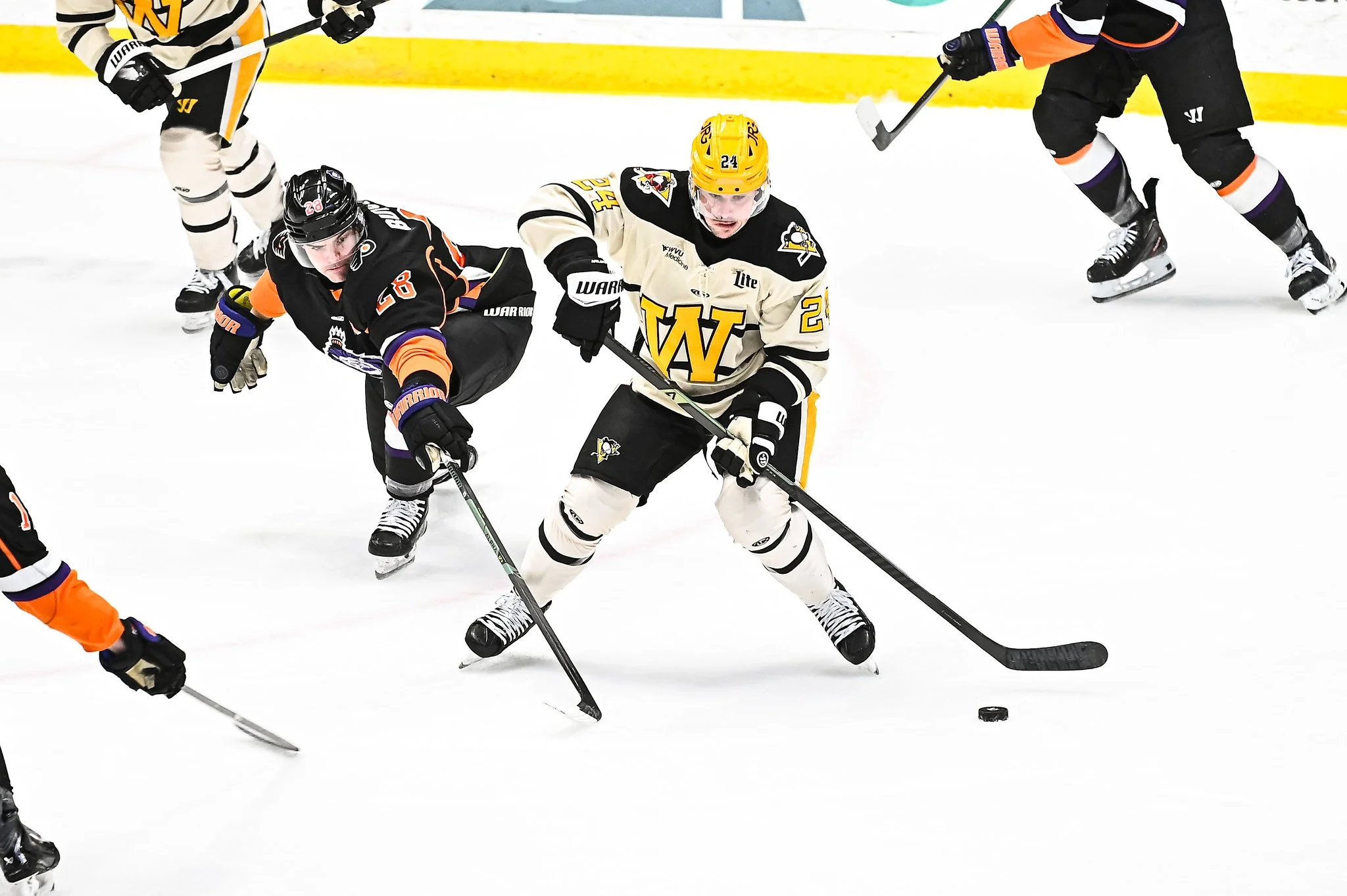
Photo Credit: Wheeling Nailers
Learning the Details of the Position
Over the course of his professional career, Thompson has developed into a reliable two-way defenseman. Much of that development, he says, comes down to the finer details of playing the position. One of the biggest keys is communication. “Communication all over the ice is one of the keys to the game,” Thompson explained. “It makes it so much easier when you're communicating, and you don't really have to look as much because everybody's kind of telling you where to go and what to do.”
For defensemen in particular, that communication becomes even more important during breakouts. “It makes it a lot easier, especially when your D partner is just telling you what they see,” he said. “When you're going back for the puck, they can look up the ice and see what's coming. It's like another set of eyes and another brain to help break the puck out.”
Another skill Thompson emphasizes is patience — something he believes separates good defensemen from great ones. “Patience is a big one for me,” he said. “When you're going back to the puck, having to hold onto it to maybe wait for the play to open up, or when you're setting up a controlled breakout, having the patience to wait out the forwards or forecheck.”
He points to the NHL’s top defensemen as examples of how valuable patience can be. “You see a lot of guys, even the best defensemen in the NHL, with so much patience where they just hold onto the puck and draw in the forecheckers and make plays with the forwards. They get odd-man rushes. It's really cool to see.”

Defense First
While offensive production can be valuable from the blue line, Thompson says strong defensive fundamentals remain the priority. “If you can get to the puck first and you don't have to use the body, it's a lot easier just to poke the puck and go,” he said. “But there are a lot of times in the game when you have a good gap and the player has the puck in tight and you just have to get in front of them and cut off their hands.”
That’s when physical play becomes necessary. “That’s when it's a good time to use your body and get in the way and separate them from the puck.”
The Emotional Side of the Game
Despite the excitement of playing professional hockey, the lifestyle comes with sacrifices — particularly when it comes to time with family. “Just missing out on a lot of stuff with your family at times,” Thompson said. “Obviously being far away, you can't always see them for holidays and birthdays.”
The reality of long seasons and travel means many players spend significant time away from loved ones. “Everybody loves the holidays, and a lot of times you can't be home,” he said. “So it's just a phone call or a text sometimes. Being away from family and friends a lot of the year is really challenging.”
Learning Through Adversity
Like any hockey player, Thompson has experienced games where the result doesn’t match the effort. He pointed to a recent matchup against the Worcester Railers as an example. “Maybe overtime last night, I had a couple good chances to score,” he said. “Only got a couple unlucky bounces. One hit his elbow, and the other one I just missed the net.”
Despite heavily outshooting their opponent, the team couldn’t find the breakthrough, in the game against the Railers. “We outshot Worcester 40 to 15, and we just couldn't find the one way to score,” Thompson said. “Those are challenging games where you play really well and you just don't have the right outcome. You just have to keep working and get on the right side of it.”

Photo Credit: Wheeling Nailers
A Passion That Never Left
Through every stop in his career, including time playing overseas, Thompson’s motivation has remained the same. “I just love playing hockey,” he said. “I can't imagine my life without it.” His competitive mindset continues to drive him each time he steps on the ice. “If you don't love competition and love wanting to be the best on the ice when you're out there and helping everybody be better, then I think you're probably in the wrong business.”
Hockey Around the World
Thompson has also seen firsthand how the game differs internationally compared to North America. “In Europe, the ice is usually an Olympic sheet, so it's a lot bigger,” he said. “The games may be more controlled at times because you have more time to make plays with the puck.”
In North America, the game is played at a different intensity. “Here it's definitely a lot more physical and tight checking,” Thompson explained. “There's nothing that really compares to the North American game with how good everybody is.”
The cultural difference surrounding the sport is noticeable as well. “In Canada especially, that's kind of what everybody does growing up,” he said. “Everybody loves hockey.”
- Samantha Wismer/Olde City Sports Network
- Photo Credit: Wheeling Nailers