

Finding His Game: Connor Fedorek’s Path to the Pros
For fourth-year defenseman Connor Fedorek, the road to professional hockey hasn’t been a straight line. It’s been a series of adjustments — to new teams, new systems, new cities — and, most importantly, to himself.
Long before he arrived in Norfolk, Fedorek’s development took shape in junior hockey, where opportunity and confidence often go hand in hand. “It was different, too, because I was on two different sides of the aisle when I was in Alaska. I was getting more into the league, and I came into a team that had only had six wins. So we were just trying to find that spark again, and then when I got traded to Odessa, it really kind of gave me the confidence to take my game to the next level because they were able to put me in a position where I felt like it fit better for me, so that confidence kind of drove me into being able to, like, work my way in and maybe get on the Pelletill right away and then eventually end up on the power play, and that kind of stuff. But I feel that, especially with my coach in Odessa, he really developed me to be able to make sure that I could play at the next level, and he gave me that opportunity, and luckily, I was able to take that one college.”
That belief carried into college hockey, where his role evolved depending on the system. At Ferris State University, structure came first. Later, at Utica University, he found space to explore his offensive instincts. “I would say Ferris, I was more defensive because that was the structure that we played and everything. When I went to Utica, I was able to bring that offensive side to me. So I think that it was kind of a healthy mix of both, where I was able to learn and adjust based on the styles of play with our team and everything, and then moving on to pro after that, where I could I can adjust to be where I need to be more defensive or offensive, but I have that structure inside of me that I can use that.”
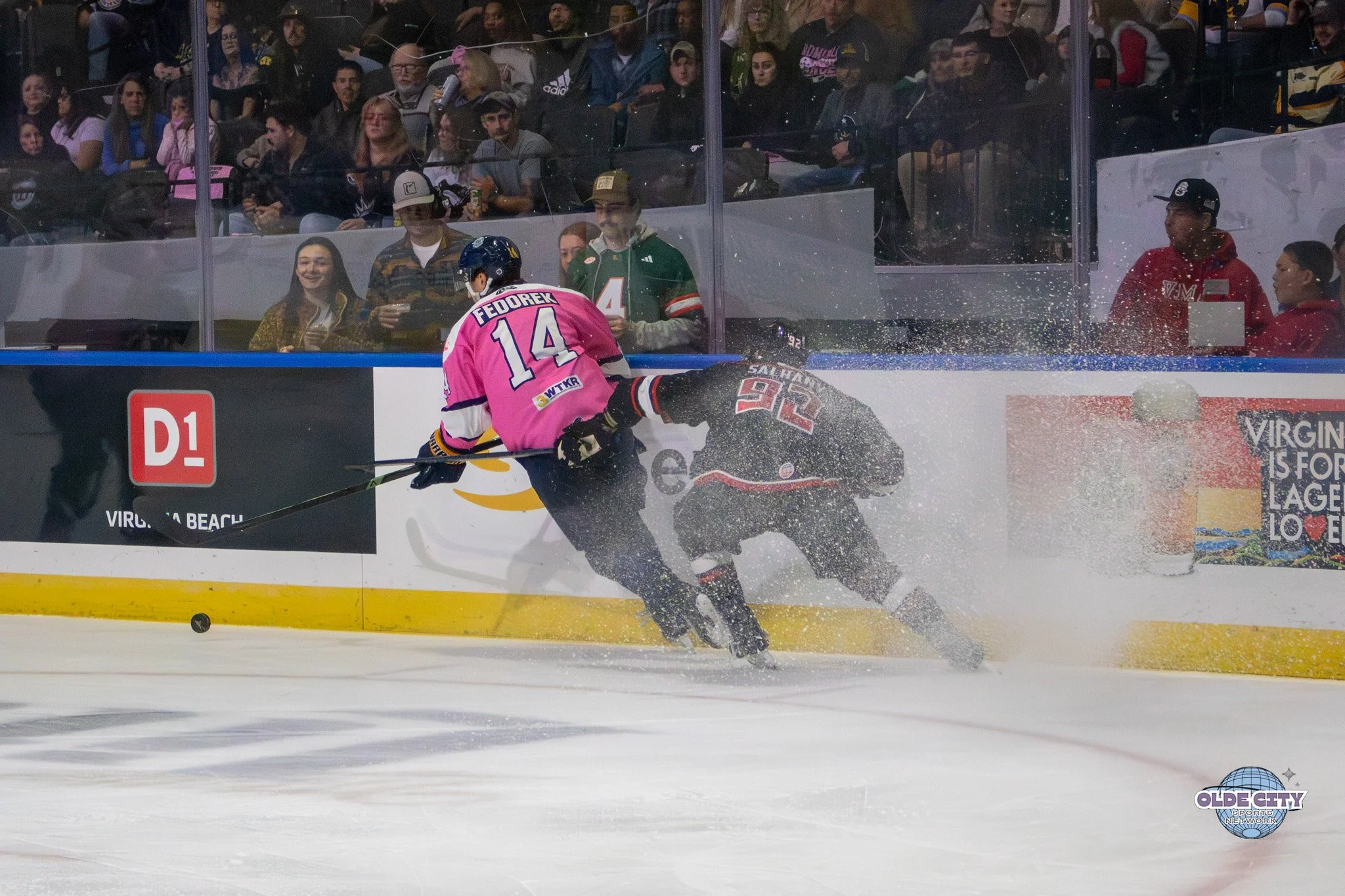
- Photo Credit: Emily Lowery/Olde City Sports Network
Turning pro was more than a contract — it was a lifelong goal realized. Kalamazoo Wings were the first to call Fedorek. “I did go to Kalamazoo, so it wasn't far from Ferris. It was kind of it was kind of like I was going back to school. It was like an hour away, but it's just something I've always dreamt of being able to do. Well, I would always say, like mini goals for myself, like when I went to juniors, and then I wanted to go to college to play division one, and then after I got to college, my goals to play pro. So it was just that next step of achieving one of those small goals, and the fact that I was able to do it within a week once my college career ended was awesome. I remember telling my parents about it. We were all getting emotional on the phone, just being like, this is the dream that we always talked about, and I'm able to finally achieve that.”
Professional hockey, though, tests more than talent. It tests routine, discipline, and adaptability. “The biggest thing is you just got to stay true to the player that you are and everything. I love coming to the rink every day. I like coming in early, staying late, that kind of stuff. So that was the biggest thing where you kind of had to adjust based on like some places I didn't really have a a car, like when I was in Indy, but we had a gym that was at the apartments too, so I was able to figure that out and have that kind of happy medium of I could leave the rink early, but I was still doing the stuff I wanted to do outside the rink. So I think the biggest thing was just making sure I didn't get away from why I'm doing this and why I want to be a pro player. And that was kind of what kept me in with everything.”
Now settled in Norfolk, Fedorek speaks with genuine appreciation about his current chapter. “It means everything to me. I get excited coming to the rink every day. I like going back to the apartments, hanging out with the guys, and all that. So I think the biggest thing is we have great fan base here and they keep us all end up with their games and everything, like all that momentum that the switches that they have with cheering us on and everything, it helps us immensly when we're at home and even in playoffs, we always fight for that home advantage because it's going to help us in the long run. But it's great. I love coming here every day.”
On the ice, Fedorek’s game is built on reads and reaction. A two-on-one demands one decision. A three-on-two demands another. “I think it depends on if it's a two-on-one versus a three-on-two, that kind of thing, but if it's a two-on-one, usually I want to keep on the outside and make sure I take that pass away so that it's more so that the goalie takes a shot and I take the pass, but a three on two, depending on how wide or narrow they are when they end of the zone, it could be more of aggressive or the 2D swing together, and we stop it right away, or we know a third guy's coming in, so we kind of sit back, and then when he gets there, then we can all grab our man.”

Speed at the pro level forces defenders to think as quickly as they skate. “I would say it's hard to match speed sometimes, because sometimes you're able to keep that speed, depending on who you're playing against, but sometimes it's more, so you need to kind of read where they're going to go, and you kind of just meet them there. You kind of cut off their path they're trying to take.”
Offensively, joining the rush is about numbers and timing. “I think more so is when you see numbers, right? So if they got two defensemen there, but we got two forwards going, the biggest thing is you want to join, so it's a three-on-two, right? And then vice versa, they have three, you want to make it four. Sometimes it could be even just four on four, and you're just adding it to line up the numbers, but the biggest thing is if you have the ice and we know we have the guys back, you just take it and if you end up, don't get in the pocket, then you're able to kind of regroup and sit back. If you're able to get the pockets more, of a trying to create as much offense as you can.”
But perhaps the clearest evolution in his game is confidence with the puck. “I think my biggest thing is just confidence with the puck and everything, because once you feel that you're going to make a play before you have to make the play, and a big thing too is once you pick up the puck, especially when you're in the neutral zone or D zone, is get your toes up the ice and search skating limp at first before you make that pass, because then it's forcing everyone back rather than just getting the puck turning around and just throwing it to somebody. So like confidence with the puck and just skating it up and being able to dish that puck off when we have speed going down.”
Growing up, Fedorek admired players who balanced mobility with composure — defensemen who could dictate pace from the back end. “I would say one of my favorite defenseman ever would have been Duncan Keith. So I don't know how much he would want to play with me now, but maybe when earlier in his career, if I would ever get that chance, I think it would have been really cool because I could have played on my offside with him, and I think it would have been a lot of fun.”
From junior trades to college transitions to carving out his role in Norfolk, Connor Fedorek’s journey has been defined by adjustment and belief. Each step — each mini goal — has brought him closer to the dream he once talked about with his parents on the phone.
And four years into his professional career, he’s still chasing the next one.
- Samantha Wismer/Olde City Sports Network
- Photo Credit: Emily Lowery/Olde City Sports Network
- Photo Credit: Norfolk Admirals